Ideas Worth Exploring · Editorial
Why Do We Bargain With the Universe?
From ancient offerings to modern manifestation, humanity has a remarkable habit of treating existence as though it accepts negotiations.
By Origins of Belief
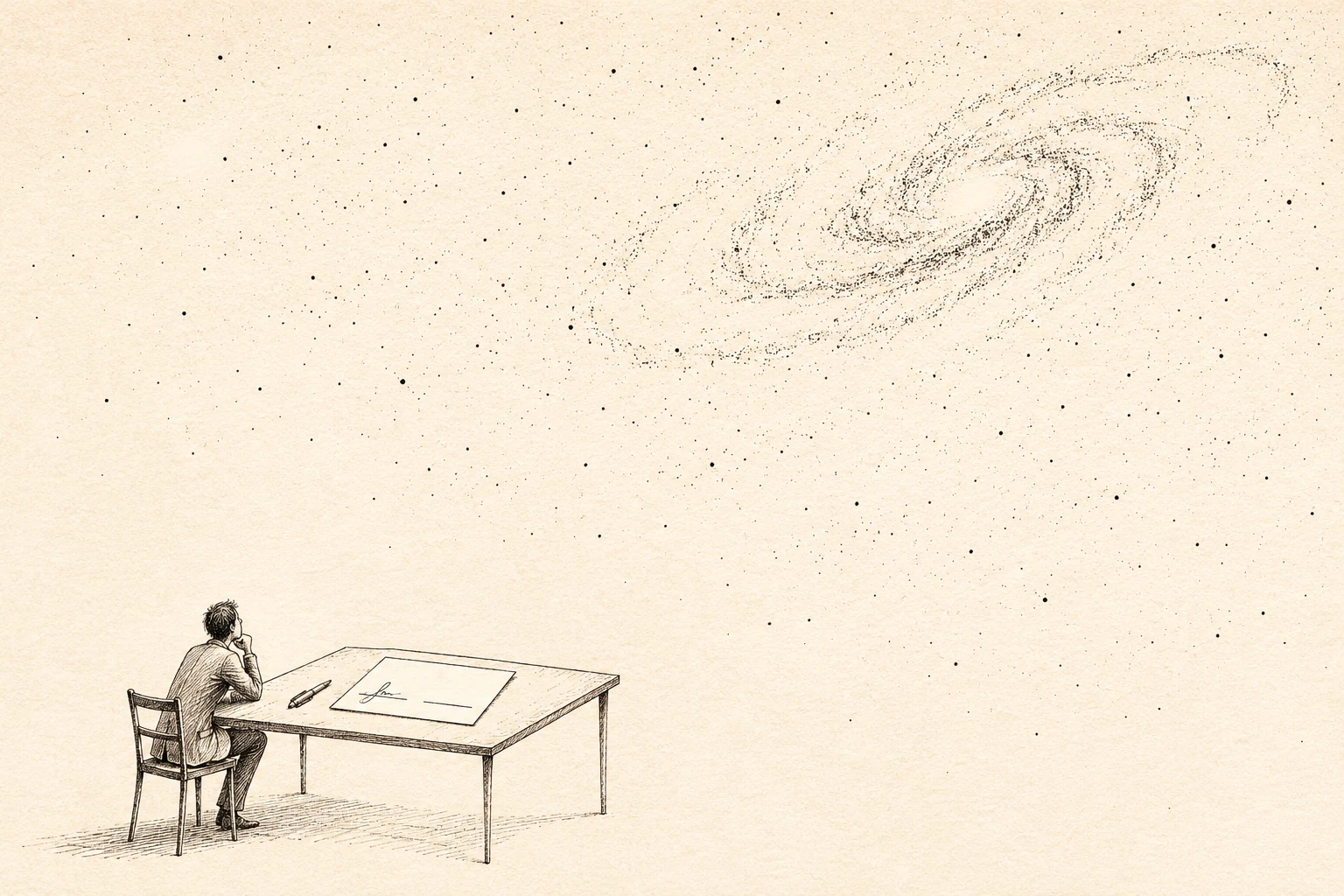
Somewhere in the world, a perfectly rational adult is promising God that they will become a better person if their medical results come back normal.
Someone else is wearing lucky socks to an important interview. Another is asking the universe for a sign, preferably one that confirms a decision they have already made.
Different beliefs. Different vocabulary. Remarkably similar negotiating tactics.
Human beings have spent thousands of years trying to establish a working relationship with the unpredictable. We have offered sacrifices, built temples, lit candles, crossed our fingers and, more recently, written our desired annual income in manifestation journals.
The methods have evolved. The underlying impulse seems remarkably familiar.
We would like reality to be open to discussion.
When the gods had a payment system
In ancient Rome, religious practice included vows, known as vota, through which people promised offerings to the gods in exchange for divine assistance.
A successful military campaign, recovery from illness or safe return from a journey might be followed by the fulfillment of such a vow.
Historians sometimes describe this reciprocal relationship using the Latin expression do ut des — I give so that you may give.
It would be misleading to reduce Roman religion entirely to transactions. It also involved communal identity, reverence, tradition and civic responsibility. Nevertheless, reciprocity was an important feature of religious life.
And it is easy to understand its appeal.
Imagine living in a world without antibiotics, reliable weather forecasts or modern emergency medicine. The difference between a successful harvest and starvation might depend on whether it rained.
An offering gave people something meaningful to do in circumstances where their practical options were limited.
The gods may or may not have been listening. But the person making the offering was no longer simply waiting.
The uncomfortable business of having no control
In 2008, psychologists Jennifer Whitson and Adam Galinsky published a series of experiments in Science examining the relationship between perceived control and illusory pattern recognition.
Their research suggested that when people experience a lack of control, they become more inclined to perceive meaningful connections between unrelated events.
A coincidence becomes a message. An accident becomes a warning. An unexpected encounter becomes destiny.
The human brain is exceptionally good at detecting patterns. Unfortunately, it is not equally good at determining whether those patterns actually exist.
This does not mean that every spiritual experience is a psychological error. Nor does it establish that religious belief is simply a response to uncertainty.
It does, however, reveal something interesting about our relationship with randomness: we often find an explanation more comforting than the absence of one.
Even an unpleasant explanation can offer a sense of order.
Perhaps this is why the idea that everything happens for a reason remains so attractive. The alternative — that some things happen without purpose, permission or moral justification — is considerably less reassuring.
The universe has been rebranded
Modern spirituality has introduced an interesting variation on the ancient bargain.
Instead of asking a deity for assistance, some people appeal directly to the universe.
Visualize the outcome. Maintain the correct vibration. Express gratitude in advance. Trust that what you desire is already on its way.
The universe, apparently, has acquired both a customer service department and a motivational coaching certificate.
There is nothing inherently unreasonable about visualization, positive thinking or setting intentions. These practices can influence motivation and behavior.
But there is an important distinction between preparing ourselves to achieve something and believing that our thoughts directly cause external events to occur.
Research by psychologist Gabriele Oettingen and colleagues has challenged the assumption that positive fantasies alone improve achievement. In some circumstances, imagining an ideal future without confronting the obstacles involved can reduce the effort people invest in reaching it.
Thinking about a promotion may help clarify what we want.
It is unlikely to replace the uncomfortable conversation with our manager.
The more troubling implication of manifestation culture emerges when the desired outcome does not arrive. If success is attributed to the quality of our thoughts, what are we supposed to conclude about illness, poverty or tragedy?
That someone failed to think correctly?
At that point, a comforting belief risks becoming an unfair moral judgment.
Does a ritual need to work to be useful?
Not necessarily.
In a 2022 experiment, researchers tested whether a short, predictable sequence of movements could ease anxiety after preparing a speech. Their results pointed to a possible small benefit, with considerable uncertainty.
A familiar sequence of actions can help us feel composed before a difficult event. A prayer can provide comfort. Lighting a candle can create space for reflection. A lucky object can carry emotional significance.
These benefits deserve recognition without requiring us to exaggerate what the rituals can accomplish.
There is a meaningful difference between saying that a ritual changes our experience of reality and claiming that it changes reality itself through supernatural means.
The first can be investigated scientifically.
The second requires a different kind of evidence.
Perhaps the universe owes us nothing
The ancient Stoic philosopher Epictetus began his Enchiridion by distinguishing between things within our control and things outside it.
Our judgments, intentions and choices belong broadly to the first category. Many external circumstances belong to the second.
It is a deceptively simple distinction and an extraordinarily difficult one to live by.
We want good people to receive good outcomes. We want suffering to have a purpose. We want effort to guarantee success and love to guarantee safety.
Yet the world does not consistently operate according to these expectations.
Perhaps maturity is not the abandonment of hope, prayer or ritual. Perhaps it is learning to engage in these practices without mistaking them for contracts.
We can hope without believing we are owed an outcome. We can pray without treating prayer as a payment. We can make plans without assuming that existence has agreed to them.
And we can wear our lucky socks.
Just in case.
Sources and further reading
- Whitson, J. A., & Galinsky, A. D. (2008). Lacking Control Increases Illusory Pattern Perception. Science, 322, 115–117.
- Kappes, H. B., & Oettingen, G. (2011). Positive Fantasies About Idealized Futures Sap Energy. Journal of Experimental Social Psychology, 47, 719–729.
- Lang, M., Krátký, J., & Xygalatas, D. (2022). Effects of predictable behavioral patterns on anxiety dynamics. Scientific Reports, 12, 19240.
- Beard, M., North, J., & Price, S. (1998). Religions of Rome, Volume 1: A History. Cambridge University Press.
- Epictetus. The Enchiridion, Section 1.