Ideas Worth Exploring · Editorial
Who Invented Tuesday?
And why are we still organizing our lives around a calendar shaped by ancient gods, religious rituals, and political decisions?
By Origins of Belief
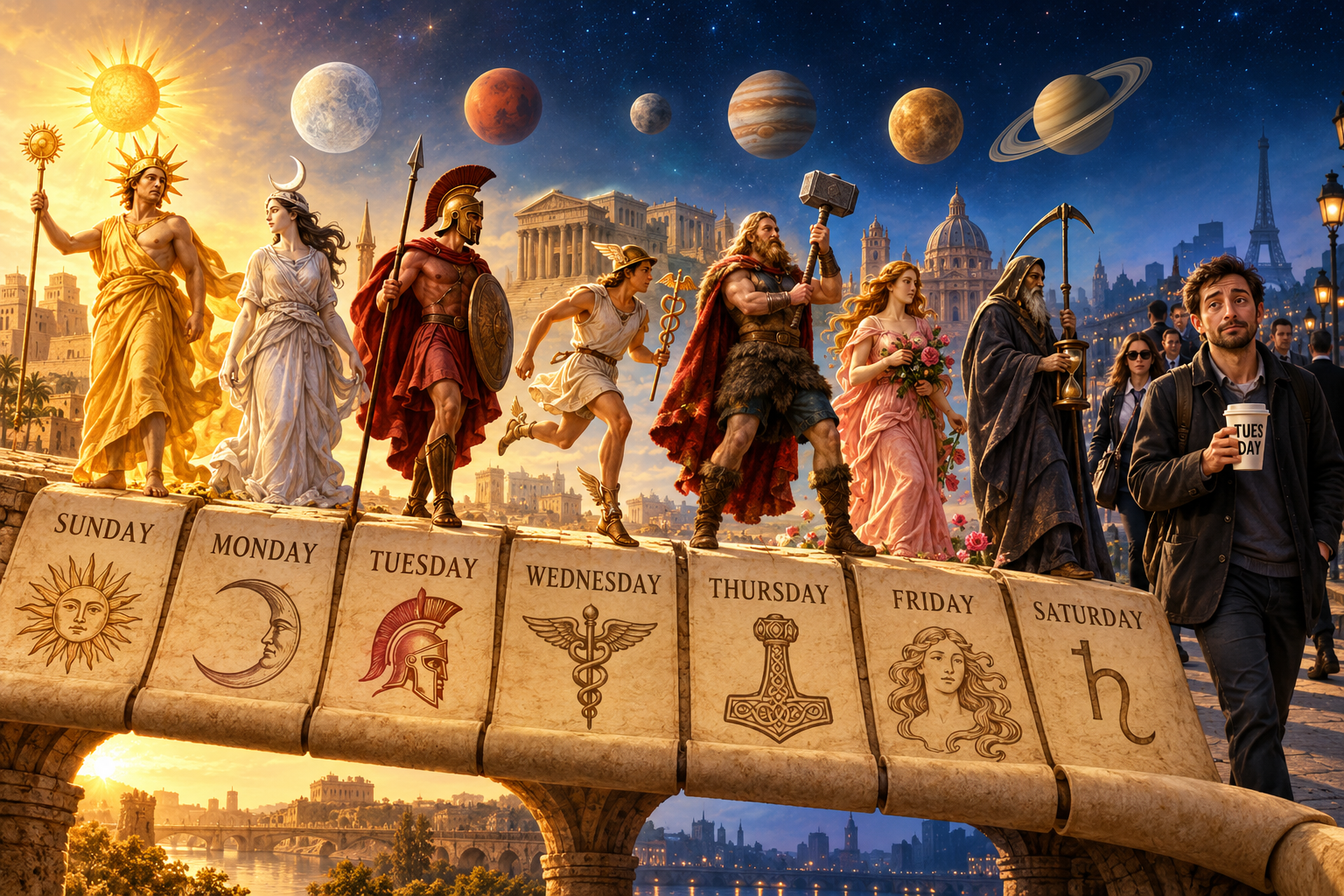
If you're reading this on a Tuesday, congratulations.
You're participating in an ancient tradition you probably never agreed to.
Nobody asked whether you'd prefer a five-day week. Or eight. Or perhaps a civilized arrangement involving three days of work followed by four days of recovering from it.
Instead, you inherited seven.
Monday arrives. Tuesday follows. Friday becomes an object of collective worship. And somewhere along the way, humanity decided this arrangement was perfectly natural.
Except there's something peculiar about the week.
A day corresponds roughly to Earth's rotation. A year follows its journey around the Sun. A month has historical connections to the Moon's cycle.
But a week?
The universe doesn't particularly care about seven days.
There's no astronomical event that occurs precisely every Tuesday. The Moon doesn't reset itself after seven days. Saturn has never announced that the weekend is approaching.
The seven-day week is a human convention.
And like many human conventions, it has a surprisingly complicated history.
The week wasn't invented in a week
It's tempting to imagine that somewhere in ancient Mesopotamia, a particularly organized Babylonian sat down and invented the seven-day week.
History is rarely that cooperative.
Ancient civilizations developed different systems for dividing time. Some followed lunar phases. Others organized recurring markets, religious observances, or agricultural activities around cycles that didn't necessarily last seven days.
The Moon completes its cycle of phases in approximately 29.5 days. Dividing that period into four gives roughly seven days per quarter.
That relationship may have helped make seven-day intervals attractive in some ancient calendars.
But lunar phases don't divide neatly into equal seven-day periods, and the historical development of the week cannot be explained by astronomy alone.
Two traditions became particularly important to the seven-day week that eventually spread across much of the world.
One was the Jewish Sabbath cycle.
The other was the planetary week of the Greco-Roman world.
They were not originally identical systems, and historians continue to investigate their development and interaction.
Their eventual convergence helped produce a calendar structure that billions of people now treat as ordinary.
When the planets were gods
In the ancient Mediterranean world, astronomy and astrology were closely connected.
People observed seven prominent celestial bodies that appeared to move against the background of the fixed stars: the Sun, Moon, Mercury, Venus, Mars, Jupiter, and Saturn.
Today, we know that the Sun is a star and the Moon is Earth's natural satellite. Ancient astronomical systems classified them differently.
These seven celestial bodies were associated with divine powers, and a planetary system of naming the days developed in the Roman world.
The English names preserve traces of that history.
Sunday remembers the Sun. Monday remembers the Moon. Saturday preserves Saturn.
Tuesday, Wednesday, Thursday, and Friday carry names derived from Germanic deities, reflecting the adaptation of Roman planetary associations into Germanic languages.
Tuesday is connected to Tiw or Týr, associated with the Roman Mars. Wednesday invokes Woden or Odin, corresponding to Mercury. Thursday recalls Thor, associated with Jupiter. Friday is commonly linked to Frigg, though the linguistic history is more complicated.
The names are historical fossils.
Most English speakers no longer think about Germanic gods when arranging a Thursday meeting.
Yet those names remain embedded in ordinary life.
The gods may have lost their temples, but they kept their places on the calendar.
The Sabbath: when rest became a commandment
The Jewish seven-day cycle developed around a different principle.
Its defining feature wasn't the naming of days after celestial bodies.
It was the Sabbath.
In the Hebrew Bible, the creation account describes six days of divine activity followed by a seventh day of rest.
The Sabbath commandment establishes a recurring rhythm of work and cessation.
But there's an important detail.
In Exodus, the commandment extends rest beyond the individual observing it. Children, servants, foreigners living within the community, and working animals are included.
In Deuteronomy, the commandment is connected to the memory of slavery in Egypt.
The theological explanations differ in emphasis: one looks to creation, the other to liberation.
Together, they present rest as more than personal relaxation.
It is a religious obligation with social consequences.
That doesn't mean ancient Israelite society consistently achieved equality or that every person experienced the Sabbath in the same way.
But the principle is significant.
Rest was not supposed to depend entirely on a person's power, wealth, or social position.
The idea that an entire community should periodically stop working was a substantial moral claim.
And it raised a question that remains relevant today.
Who gets to rest—and who must keep working so everyone else can?
Rome had eight days. Then seven took over.
Before the seven-day week became dominant, the Romans used an eight-day market cycle known as the nundinal cycle.
It organized recurring market days and aspects of public life.
The Roman calendar therefore already contained a repeating social rhythm, but it wasn't the same as our modern week.
The seven-day planetary cycle spread through the Roman world during the early imperial period, and for a time the two systems coexisted.
This matters because the familiar story that one emperor suddenly replaced an eight-day week with a seven-day one oversimplifies a gradual cultural change.
By the fourth century CE, the seven-day week was well established.
Then Emperor Constantine gave Sunday a new legal status.
In 321 CE, he ordered judges, urban populations, and craftspeople to rest on the day of the Sun, while allowing agricultural work to continue under specified circumstances.
Constantine didn't invent the seven-day week.
He didn't invent Christian Sunday worship either.
But his legislation helped establish a particular weekly day of rest within Roman civil life.
Christian observance of Sunday, connected with the resurrection of Jesus, existed before his decree.
The Roman planetary tradition and Christian religious practice thus became increasingly intertwined within imperial institutions.
The result wasn't simply a new way of measuring time.
It was a way of coordinating work, worship, government, and social life.
And once an entire society begins organizing itself around a shared schedule, changing that schedule becomes surprisingly difficult.
The French Revolution tried to redesign time
In 1793, revolutionary France introduced a new calendar.
The revolutionaries had already challenged monarchy, aristocratic privilege, and the political authority of the Church.
Why stop at government when you could reorganize the calendar?
The French Republican calendar replaced traditional month names with names associated with seasons and agriculture.
It also replaced the seven-day week with a ten-day cycle called a décade.
Each month contained three décades, and the tenth day, the décadi, became the principal recurring day of rest.
The reform was intended partly to weaken the influence of the old religious calendar and establish a civic system aligned with revolutionary ideals.
There was a certain intellectual elegance to the arrangement.
Ten was a convenient number for decimal organization.
Unfortunately, it also meant that the regular rest day arrived every tenth day rather than every seventh.
For people accustomed to a weekly rest, the new rhythm could be burdensome.
The calendar also encountered resistance because religious observances, work habits, and community life were already organized around older cycles.
The French Republican calendar survived for little more than twelve years before Napoleon abolished it, restoring the Gregorian calendar effective January 1, 1806.
Its failure had multiple causes, including political change and difficulties of implementation.
But the experiment revealed something important.
A calendar isn't merely a mathematical system.
It is a social institution.
Changing the numbers is easier than changing the lives organized around them.
The Soviets tried something even stranger
In 1929, the Soviet Union began experimenting with a continuous production calendar.
The goal was economic efficiency.
Under a five-day cycle, workers were assigned staggered rest days so factories and other workplaces could continue operating.
Rather than everyone stopping work at the same time, different groups rested on different days.
From the perspective of industrial planning, this offered an appealing possibility: more continuous use of expensive machinery.
But human life doesn't organize itself entirely around production.
A worker's rest day might not coincide with that of a spouse, relatives, or friends.
Shared religious observances and social gatherings could also become harder to coordinate.
The experiment encountered practical and administrative difficulties, including problems involving maintenance, organization, and productivity.
In 1931, the Soviet government moved to a six-day calendar with common rest days on specified dates of the month. In 1940, it restored a conventional seven-day workweek.
The changes reflected economic and political priorities as well as social pressures.
Still, the experiments demonstrated a basic problem with treating rest as an individual scheduling variable.
A day off isn't nearly as useful when everyone you love is at work.
Time has a social dimension.
We don't simply need hours away from our jobs.
We need opportunities to share those hours with other people.
So why seven?
The seven-day week wasn't inevitable.
Human societies have used different recurring cycles, and governments have demonstrated that alternative systems are technically possible.
But once a weekly rhythm becomes widespread, it acquires enormous practical advantages.
Families can coordinate gatherings.
Religious communities can organize worship.
Businesses can plan operations.
Schools, markets, and public institutions can synchronize their activities.
The value of a shared calendar increases as more people use it.
Economists sometimes describe similar phenomena as network effects: a system becomes more useful when many people participate in it.
That doesn't mean the seven-day week is mathematically superior to every alternative.
It means replacing it would require coordination on an extraordinary scale.
Imagine trying to persuade the entire world to switch to an eight-day week.
You would need to reconsider employment contracts, school schedules, international commerce, religious observances, transportation systems, and countless everyday routines.
And then you'd have to explain to everyone why their birthday now falls on a different weekday than expected.
The problem isn't that eight is impossible.
It's that seven has become shared infrastructure.
The strange reality of invented time
There's a philosophical distinction worth making.
The rotation of Earth is a physical process.
Our decision to divide that rotation into twenty-four hours is a convention.
The planet's journey around the Sun is a physical process.
The calendar used to organize that journey is a human construction.
Likewise, the seven-day week is not a law of nature.
But calling something a human construction doesn't make it meaningless or unreal.
Money is a human institution.
So are legal systems, national borders, and many of the rules governing everyday life.
Their effects are real because people organize their behavior around them.
The week belongs to that category.
Its boundaries are conventional, but its consequences are concrete.
A person can lose wages because of a scheduling rule. A family can gather because of a shared holiday. A community can preserve an identity through recurring religious observances.
The week shapes what people do, when they meet, and how they experience the passage of time.
And perhaps most importantly, it gives time a recognizable rhythm.
Without recurring intervals, days might become harder to distinguish from one another.
The week creates anticipation.
Monday can feel like a beginning.
Friday can feel like relief.
Sunday can carry spiritual meaning, family expectations, or the uncomfortable realization that tomorrow is Monday again.
These feelings aren't produced by astronomy.
They're produced by culture, habit, and shared experience.
The gods are gone. Tuesday remains.
The history of the seven-day week brings together religious observance, celestial symbolism, imperial legislation, revolutionary ambition, and industrial planning.
No single civilization or individual can claim sole responsibility for the entire system we use today.
It emerged through centuries of development, adaptation, and standardization.
And its persistence tells us something about human institutions.
Traditions don't survive only because people believe the stories that originally gave them meaning.
They can also survive because they become useful, familiar, and deeply integrated into collective life.
Millions of people who don't believe in Thor still make plans for Thursday.
People who disagree profoundly about religion can nevertheless agree that the weekend is too short.
Perhaps that's the most revealing part of the story.
Humanity has never reached a universal agreement about the nature of God, the purpose of existence, or what happens after death.
But we've managed to coordinate an extraordinary amount of life around seven repeating days.
We invented the week. Then we built a world that made it difficult to imagine living without one.
For the curious
1. Ilaria Bultrighini and Sacha Stern (2021). “The Seven-Day Week in the Roman Empire: Origins, Standardization, and Diffusion.” A scholarly examination of the Jewish and planetary weekly traditions and their development in the Roman world. Research publication.
2. Mark Anderson (2019). “Christianizing the Planetary Week and Globalizing the Seven-Day Cycle.” Studies in Late Antiquity. Research on the interaction of Christian practices and the planetary week. Academic article.
3. Exodus 20:8–11 and Deuteronomy 5:12–15. Primary texts presenting the Sabbath in relation to creation, rest, and liberation. Read the passages.
4. Fondation Napoléon. “The Republican Calendar.” Background on the French Revolutionary calendar and its abandonment under Napoleon. Historical overview.
5. History. “For 11 Years, the Soviet Union Had No Weekends.” An accessible account of Soviet experiments with continuous production and alternative work cycles. Read the article.