Who Decided Heaven Was Up?
And why does hell always seem to be downstairs?
Origins of Belief | Ideas Worth Exploring
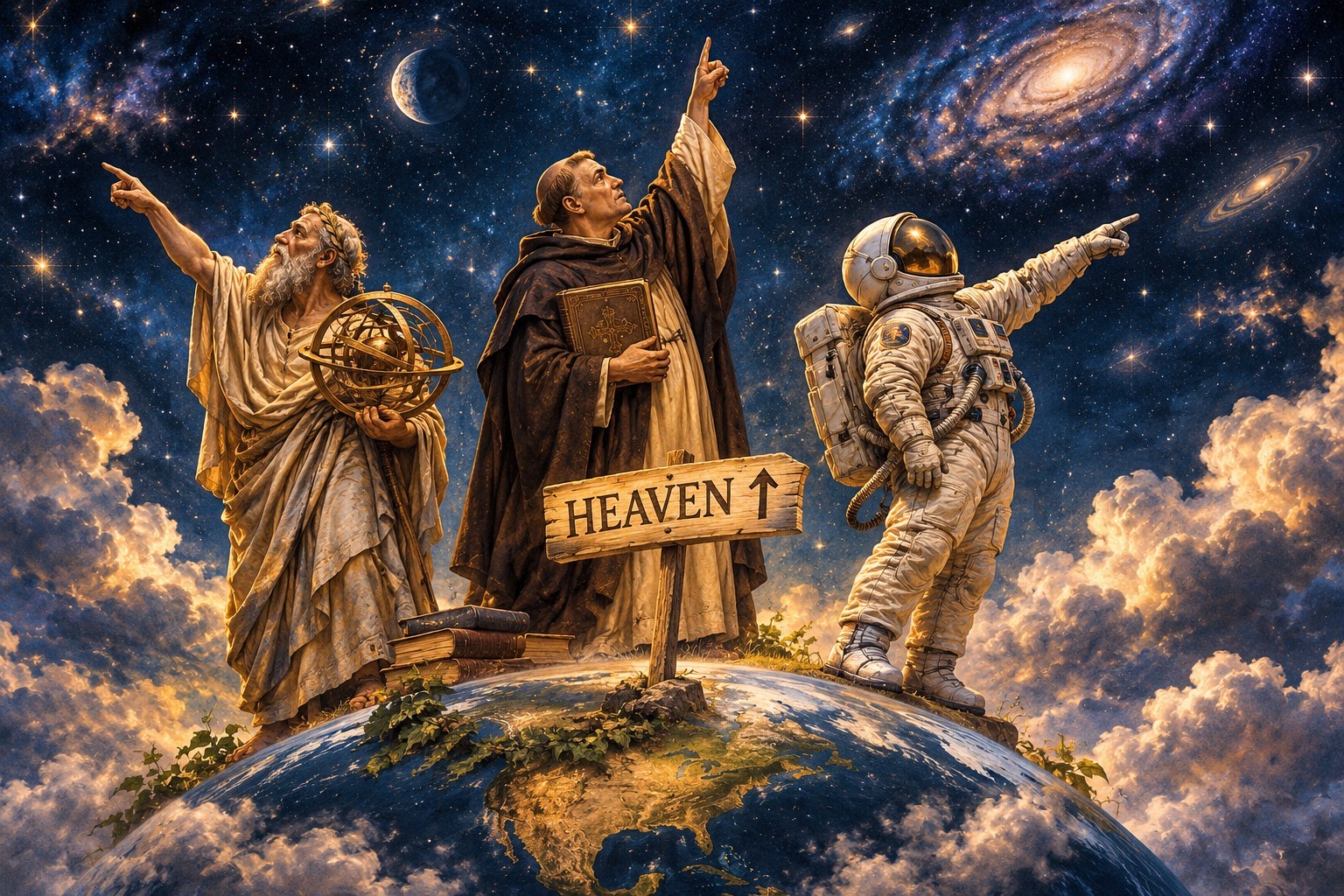
If heaven is above us and hell is below us, there's an obvious question nobody seems particularly eager to answer.
Above where, exactly?
If you're standing in New Jersey, heaven is presumably somewhere over your head. But someone in Australia is standing on the opposite side of the planet, pointing toward an entirely different patch of space.
Are there two entrances?
Does heaven rotate with Earth?
And if we eventually build a hotel on Mars, will the directions change?
For thousands of years, humans have spoken about the afterlife as though it occupies a perfectly sensible location. The good go up. The wicked go down. Angels descend. Demons rise. God looks down upon humanity, presumably with a mixture of affection and concern.
The arrangement is so familiar that we rarely question it.
But the universe has no universal up or down.
So who gave eternity a floor plan?
Before heaven was a destination, the sky was a mystery
Imagine living thousands of years ago, before telescopes, satellites, or the discovery that Earth is one planet among countless celestial bodies.
Every morning, the Sun rises.
Every evening, it disappears.
The Moon changes shape. Stars move across the darkness. Thunder erupts from clouds. Lightning falls from the sky with terrifying precision.
Meanwhile, the dead disappear into the earth.
The contrast is almost too convenient.
Above us: light, warmth, rain, celestial movement, and forces beyond human control.
Below us: darkness, burial, decay, and the mysterious disappearance of those we love.
If you were going to construct a symbolic map of existence, the sky and the ground would be obvious places to begin.
But there is an important distinction.
The sky did not automatically become heaven, and the underground did not automatically become hell.
Different cultures developed very different ideas about divine realms, the dead, and what happened after life ended.
What they shared was a tendency to interpret the visible world through stories about invisible realities.
The landscape became a language for explaining existence.
And the sky offered particularly impressive vocabulary.
The ancient universe had architecture
In the creation account of Genesis, God separates waters above from waters below by establishing an expanse, traditionally translated as a firmament.
This description reflects a conception of the cosmos very different from modern astronomy.
Ancient Near Eastern societies imagined the world through arrangements of earth, sky, celestial bodies, and cosmic waters. Their models varied, but the heavens were not generally understood as the vast, mostly empty space described by contemporary astrophysics.
The Hebrew word raqia, used in Genesis, has generated considerable scholarly discussion. Some interpreters understand it as a solid vault; others emphasize its appearance as an extended space.
The broader point is less controversial: the text belongs to an ancient cosmological world, not a modern scientific one.
The sky was part of an ordered creation.
The heavens could be imagined as the dwelling place or domain of divine beings.
The earth was humanity's home.
And beneath it lay another mysterious realm.
A vertical universe was a comprehensible universe.
It gave everything a place.
Even the things nobody had actually visited.
Biblical scholars have examined how this cosmological framework differs from modern understandings of the universe. The distinction matters because interpreting ancient religious texts as though their authors possessed contemporary astronomical knowledge can obscure what those authors were actually describing.
The Greeks sent almost everyone downstairs
The ancient Greeks had a different arrangement.
Their gods famously occupied Mount Olympus, although divine existence was not confined to one geographical mountain.
The dead, meanwhile, generally traveled to the realm of Hades.
But Hades was not simply the Greek version of Christian hell.
It was the domain of the dead.
Not everyone who entered it was being punished.
In Greek literature and mythology, the afterlife could include gloomy regions, places of punishment, and more pleasant destinations reserved for favored individuals.
Tartarus was associated with imprisonment and punishment. Elysium, or the Elysian Fields, offered a more fortunate existence, although its location and meaning changed across different texts and periods.
In some early traditions, Elysium was imagined at the far edges of the earth rather than deep underground.
Later accounts could place blessed regions within the underworld itself.
Apparently, even the ancient Greeks couldn't agree on the real estate.
The important difference is that the Greek underworld was not organized around the simple assumption that everyone below was wicked.
Death itself was the central dividing line.
The morally elaborate sorting systems familiar from later religious imagination developed in different ways across centuries.
The geography of the afterlife was never as stable as our modern cartoons suggest.
The Bible's underworld wasn't originally Dante's inferno
Here's where things become especially interesting.
In much of the Hebrew Bible, the realm of the dead is called Sheol.
It is often portrayed as a shadowy destination associated with death, silence, and separation from ordinary earthly life.
Sheol is not consistently presented as a place where morally wicked people receive fiery punishment.
The righteous and unrighteous alike can be described as going down to the dead.
Over time, Jewish traditions developed increasingly varied ideas about resurrection, judgment, punishment, and the world to come.
Early Christianity emerged within that diverse Jewish religious environment.
Christian teachings about the afterlife subsequently developed through interpretations of scripture, theological debate, cultural exchange, and centuries of religious imagination.
This history matters because the familiar picture of heaven as a beautiful kingdom in the clouds and hell as an underground torture chamber was not delivered as a single, complete architectural plan.
It developed.
And some of its most memorable features came from sources that weren't biblical instructions at all.
One of the most influential contributors was a medieval Italian poet with a remarkable talent for making theological geography unforgettable.
Dante gave the afterlife a guided tour
In the early fourteenth century, Dante Alighieri wrote The Divine Comedy.
It is difficult to overstate the cultural influence of this poem.
Dante imagined himself traveling through hell, purgatory, and paradise.
His hell descended through nine circles toward the center of Earth.
His purgatory rose as a mountain on the opposite side of the globe.
His paradise unfolded through celestial spheres surrounding Earth, culminating in the Empyrean, a realm beyond ordinary physical space.
This was an extraordinarily ambitious combination of poetry, theology, philosophy, astronomy, and political commentary.
Dante didn't invent heaven or hell.
He didn't create the idea of divine judgment.
And his descriptions were not universally accepted Christian doctrine.
But he gave generations of readers a remarkably vivid way to picture the invisible.
His universe had structure.
It had direction.
It had levels.
It even had recognizable people assigned to particular locations, sometimes for reasons involving Dante's personal opinions.
Imagine writing a poem so influential that centuries later people still confuse your creative decisions with official religious geography.
That's literary success on a nearly supernatural scale.
Yet Dante's cosmology was more sophisticated than a simple diagram of heaven stacked above hell.
The highest paradise in his poem was ultimately immaterial, beyond the physical heavens. Its significance was theological rather than merely astronomical.
His universe was a moral and spiritual construction as much as a physical one.
Then astronomy complicated the directions
For much of European intellectual history, the dominant astronomical model placed Earth at the center of a system of celestial spheres.
This was not simply a religious invention.
It was also a sophisticated scientific model developed and refined through ancient Greek astronomy.
But the model had a convenient feature for religious imagery.
There was a center.
There were outer heavens.
There was an intelligible distinction between the earthly realm and the celestial realm.
The universe possessed an apparent hierarchy.
Then the scientific picture changed.
Nicolaus Copernicus proposed a Sun-centered planetary model.
Galileo Galilei used telescopic observations to challenge important assumptions about the heavens.
Johannes Kepler developed laws describing planetary motion.
Later discoveries revealed that the Sun was one star among enormous numbers of others, located within a galaxy that is itself one among countless galaxies.
Modern astronomy no longer provides the tidy layered universe imagined by medieval cosmology.
Earth has no privileged position at the center of everything.
And up is not a cosmic destination.
It is a local direction.
When we say something is above us, we generally mean away from Earth's center.
For someone standing on the opposite side of the planet, that direction points the other way.
Both people are correct.
Neither is pointing toward a scientifically identifiable entrance to paradise.
But this did not necessarily destroy religious belief.
Instead, it forced a distinction that had always been available, even if it was not always emphasized.
Perhaps heaven was never meant to be understood as a physical address.
What if heaven isn't a place?
Many contemporary religious thinkers understand heaven less as a location somewhere beyond the stars and more as a state of communion with God, a transformed mode of existence, or a reality beyond ordinary physical description.
Within Christianity, these interpretations coexist with teachings about bodily resurrection and the renewal of creation.
They are not all identical.
Some traditions emphasize the resurrection of the dead and a transformed creation rather than an eternal existence in a distant celestial location.
Others retain more concrete images of heavenly realms.
And many believers combine symbolic and literal language without considering the two contradictory.
Religious language has always used metaphors to describe things that may resist ordinary description.
We speak of falling in love.
Rising above our circumstances.
Feeling down.
Reaching a higher understanding.
Nobody assumes love is located at a particular altitude.
We understand the metaphor.
The question is whether heaven and hell function in a similar way.
For some believers, they do.
For others, they describe realities that exist independently of human language, even if their precise nature remains mysterious.
And for skeptics, the changing geography of the afterlife may suggest that these descriptions tell us more about human imagination than about an independently existing destination.
The historical evidence can show us how these ideas developed.
It cannot, by itself, settle whether an afterlife exists.
That is a different question.
Why does goodness go up?
There is another reason heaven has remained above us even after astronomy made the old geography difficult to defend.
Our minds seem particularly comfortable connecting physical height with abstract value.
We speak of high ideals, lofty ambitions, elevated thinking, and people rising to greatness.
We also speak of low behavior, moral decline, and falling from grace.
These associations are not universal in every detail, and cultures can organize their metaphors differently.
But vertical imagery is widespread.
Part of the explanation may come from embodied experience.
As children, we learn about the world through our bodies.
Standing upright is associated with activity and agency.
Falling is associated with danger.
Looking upward reveals the sky, sunlight, and distant objects beyond our reach.
Looking downward reveals the ground, darkness beneath surfaces, and the place where bodies are buried.
Physical experience helps shape abstract language.
Once a culture associates height with authority or virtue, religious imagery can reinforce the connection.
Kings sit on elevated thrones.
Gods inhabit mountains.
Angels descend from above.
The imagery feels natural because it has become deeply familiar.
But natural-feeling isn't the same as inevitable.
We can understand why humans created these associations without assuming that the universe itself endorses them.
The map may reveal something important about the mapmakers.
The uncomfortable problem with spiritual geography
There's a deeper question hiding beneath all this talk of directions.
Why do we need the universe to reflect our moral expectations?
We want goodness to lead somewhere beautiful.
We want cruelty to have consequences.
We want death not to erase every distinction between a life of compassion and a life of deliberate harm.
These desires are understandable.
They also create a powerful incentive to imagine a universe in which justice is built into the architecture.
The good rise.
The wicked fall.
The universe keeps score.
But reality, at least the part we can observe, doesn't consistently behave that way.
Kind people suffer.
Cruel people prosper.
Justice often requires human effort precisely because it does not arrive automatically.
An afterlife organized around moral judgment offers one possible response to this problem.
It promises that the apparent injustices of earthly life are not the final word.
For believers, that promise can express profound hope.
For critics, it raises difficult questions about evidence, punishment, mercy, and the danger of postponing justice until after death.
Both perspectives deserve serious consideration.
The important thing is to recognize that the geography is doing philosophical work.
Heaven isn't merely above us because ancient people looked at the stars.
It is above us because we have repeatedly associated height with transcendence, authority, purity, and hope.
Hell isn't merely below because people buried their dead.
It is below because descent has become a powerful image of loss, danger, judgment, and separation.
These locations communicate values.
Even when they no longer describe a plausible physical map.
Perhaps we've been asking the wrong question
Imagine someone asking you to point toward heaven.
You could look upward.
You could explain that Earth is round.
You could discuss ancient cosmology, medieval theology, and the expansion of the universe.
You could mention that a spacecraft traveling in the direction you're pointing would encounter space, not a set of pearly gates.
All of that would be true.
But perhaps the more revealing question isn't where heaven is.
It's why we have always wanted to know.
Humans struggle with uncertainty.
We especially struggle with uncertainty about death.
A location gives the unknown a shape.
A journey gives death a narrative.
A destination makes separation feel less absolute.
And a moral universe offers the possibility that our choices matter beyond the brief span of our lives.
None of this proves that heaven is imaginary.
Nor does it prove that heaven exists.
It shows that our descriptions of the afterlife are inseparable from the human experiences, cultures, and questions that produced them.
We looked toward the sky and imagined something greater than ourselves.
We looked toward the earth and wondered where the dead had gone.
Then we built stories connecting the two.
And eventually, we began treating the stories as directions.
Perhaps the most interesting thing about heaven being above us isn't what it tells us about the universe.
It's what it tells us about the people who kept looking up.
For the curious
1. John R. Roberts, “Biblical Cosmology: The Implications for Bible Translation” (2013). Published in the Journal of Translation, this scholarly study examines the ancient Near Eastern cosmological assumptions reflected in Genesis and their implications for modern interpretation.
https://doi.org/10.54395/jot-583n6
2. Homer, The Odyssey, Book 4, and Virgil, The Aeneid, Book 6. Classical literary sources illustrating different Greek and Roman conceptions of the afterlife, including Elysium and the underworld. These should be read as literary evidence rather than a single, uniform ancient doctrine.
3. University of Leeds, “Dante's Idea of Paradise and the Cosmos.” An accessible academic explanation of Dante's geocentric cosmology and the theological significance of the Empyrean.
https://ahc.leeds.ac.uk/discover-dante/doc/paradiso
4. Paolo Maraner, “Dante's Medieval Cosmology” (2015). A visual and explanatory treatment of the spatial organization of Dante's imagined universe.
https://demonstrations.wolfram.com/DantesMedievalCosmology/
5. George Lakoff and Mark Johnson, Metaphors We Live By (1980). An influential work in cognitive linguistics examining how physical experience helps structure abstract concepts, including spatial metaphors. Its theoretical framework is influential but remains open to scholarly debate.